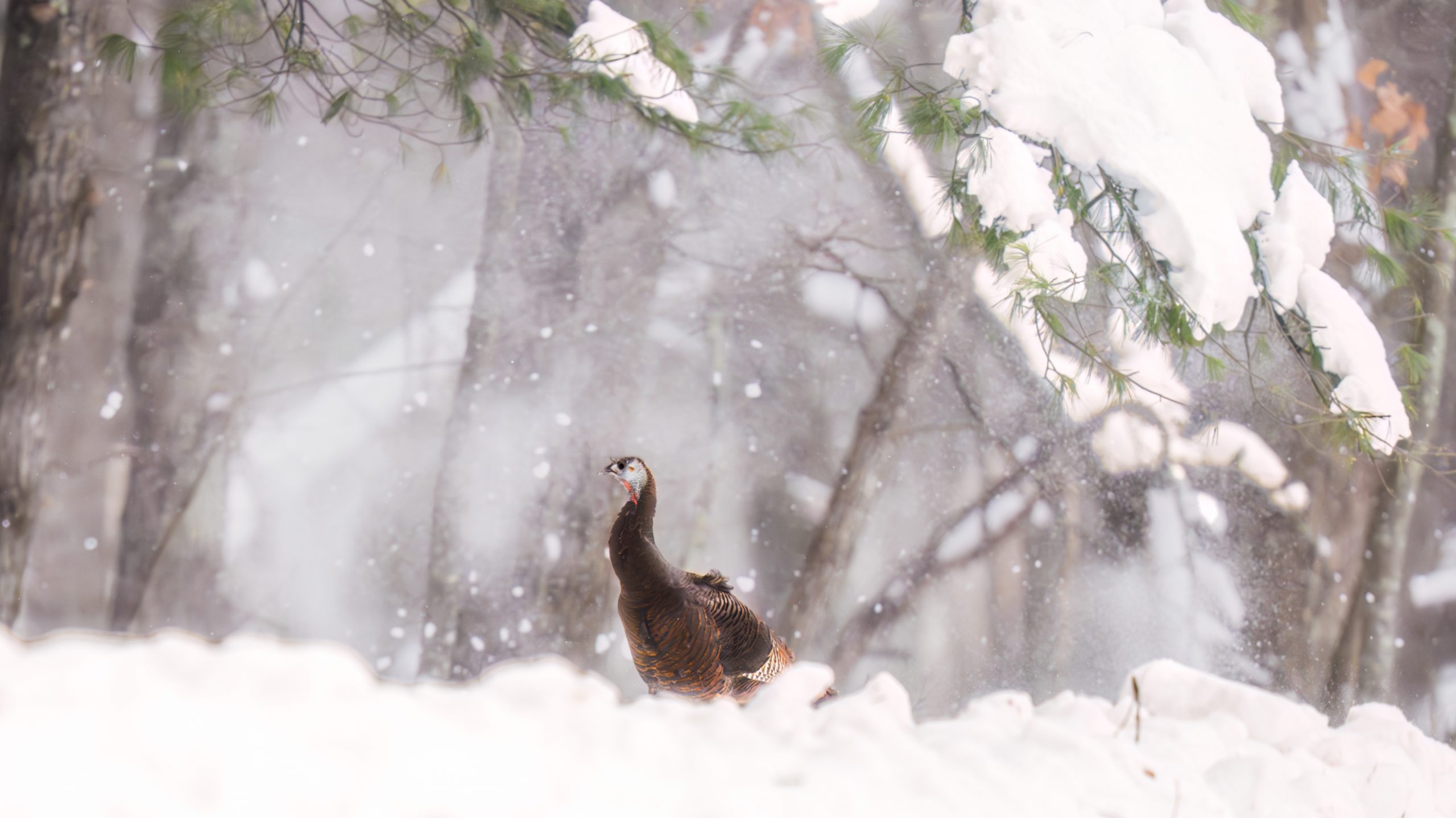
Winterized Habitat
Prepare your land to help wild turkeys and other wildlife survive the cold to come.
Milder winters have helped wild turkeys recover and expand in the American Northwest, Northeast and Midwest. Harsh winters are another story. Deep snow that arrives early and stays late, multi-week stretches of bone-chilling cold and frigid winds, or storms with freezing rains that coat the landscape in ice and lock away foods often limit how far north wild turkey flocks can survive, let alone flourish.
Putting in the work on your property during temperate months can generate forage and cover turkeys need to get through the leanest days of their year.
“Two main things affect winter survival,” said Clayton Lenk, NWTF’s district biologist for Minnesota, North Dakota, South Dakota and Wisconsin. “First, turkeys need thermal cover to battle the extreme temperatures that we can see occasionally. Second, winter food sources must be available.”
Winter cover, on the ground or in roost sites, protects birds from the energy sapping ravages of blustery winds, stinging sleet or driving snowstorms.
Conifers are King
“When you think about planting options to enhance cover, it does depend on the property – whether you’re on high or low ground. Soil types and water saturation levels can vary with elevation. For example, red pines need drier soil. Saturated soil will kill them,” Lenk explained.
“Conifers keep their needles on all year and provide the kind of microclimate that is needed in the winter,” he added. “They protect birds from the wind and can keep smaller, surrounding areas just a little bit warmer, allowing them a chance to soak up the sun.”
Spruce are better at blocking wind and snow. They tend to be shorter and stouter and have denser needle composition. Pines are tough to beat when it comes to winter cover and red and white pines offer birds roosting options if the trees are large enough, Lenk said.
“Any type of conifer that keeps its needles year-round will block wind,” he added. “Jack pine is certainly better than a deciduous tree but isn’t the best for roosting and is generally difficult to transplant or establish.”
Lenk advises avoiding red cedar, noting it tends to expand into open areas and pastureland. It demands active management, including cutting or burning, to keep it under control.
“I recommend doing a little research on what species to plant for your specific property, keeping in mind your habitat goals and the physical location of where you will be planting,” Lenk said. “Just picking out any species and planting it in the ground will not always yield results so knowing what species you have and where you’re putting it will increase the odds of success.” Lenk also said USDA Natural Resources Conservation Service agents and Soil and Water Conservation District staff in your county can offer recommendations for your local area.
“Conifers will give you the best windbreak and microclimate in severe and extreme cold temperatures,” Lenk added. “But if you can’t get your hands on any of those or just don’t have any desire to plant conifers, I’d recommend dogwoods or similar native shrubs. Stick to native species. Avoid nonnatives or cultivars (cultivated plant selected for specific traits). Plant something that grows a little shorter to the ground, something with lots of stems and can also withstand the wind.”
In the Midwest, Lenk advised mixing conifers within a woodland stand can be beneficial but should not be the focus. Landowners should target areas where turkeys are known to winter or that have good winter habitat potential.
“Also keep in mind the density at which woody species occur on your property,” Lenk said. “A high volume of stems in a concentrated area, such as a 2-year-old aspen cutting, will not initially produce quality habitat for wild turkey as it is generally too thick for them to navigate or see threats effectively.”
Keep the Pantry Stocked
Mast-producing plants, those that yield fruits, nuts or seeds, are critical to fueling turkey flocks through winter, when food sources are already minimal and dwindling. When it comes to hard mast, oaks are an obvious choice, Lenk says.
“Acorns have a ton of nutritional value. Bur and red oak are fairly common and white oak and swamp white oak can be common depending on where you are in the Midwest, especially further south. American and beaked hazelnut are great choices, too, for another hard mast. It really depends on your geographic location, and that’s where research is vital to planting the proper species.”
Lenk recommends blending a variety of mast-producing trees and shrubs. Mix it up and include soft mast species.
“Plant shrubs like highbush cranberry, wild plum, chokecherry or serviceberry,” he said. “These plants will hold fruit, and while this food won’t last all winter long, it can be available until the early winter. Songbirds and other smaller-bodied birds will also avail themselves of this food.”
Eating a variety of soft mast in summer and fall and augmenting by loading up with nutritious insects helps turkeys add invaluable fat reserves. Even though those fruits and berries won’t last into the winter, reserves help ensure turkeys survive when they’re burning more calories than they’re taking in, especially when “Old Man Winter” makes life tough.