WildturkeyDNA Project Rolls On
In year No. 2, the collaborative project is diving deep into turkey genetics, hybridization and other issues.
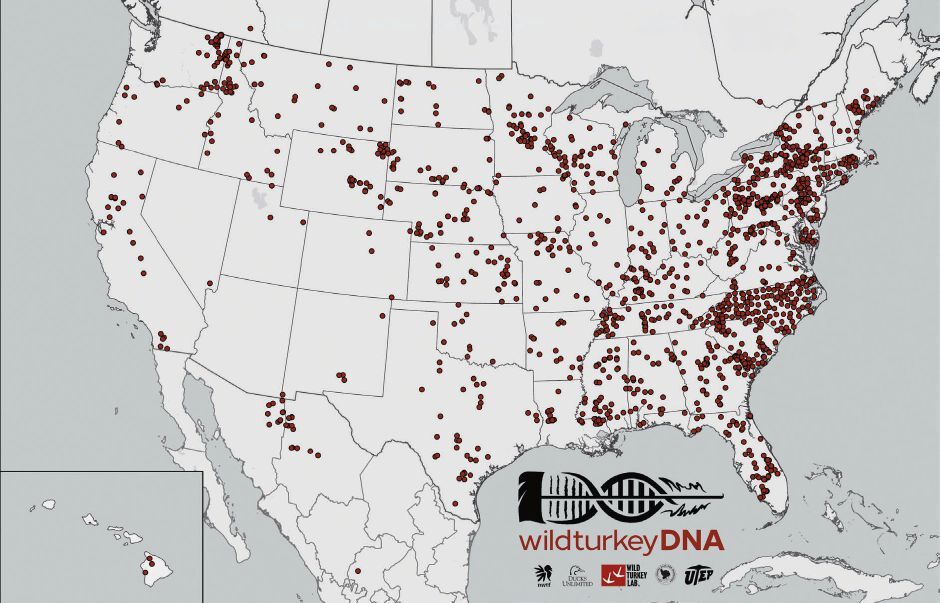
The largest citizen-science study ever conducted on wild turkeys has already revealed surprising information about the birds, and data from the effort’s second year and beyond could help boost hunting and populations throughout the turkey’s range.
WildturkeyDNA — a collaborative project spearheaded by the Wild Turkey Lab, the National Wild Turkey Federation, Ducks Unlimited, the University of Texas at El Paso and the Low Country Game Bird Foundation — recently completed its second year of sample collecting, testing and analysis. The effort seeks assistance from hunters to study wild turkey genetics on a broad scale, hoping to gain a better understanding of population genetics across the species’ range, and uncover scientific data that can inform hunters, wildlife managers, and state and federal agencies.
During year No. 1, the project sought to improve the overall understanding of the origins of color variations in turkey feathers and the potential for color phases in wild turkey populations. In year No. 2, biologists are evaluating several topics related to population and landscape genetics across the species’ range, including levels of genetic diversity, inbreeding potential, hybridization among subspecies, gene flow and estimates of effective population sizes.
“This expansion was planned and is framed around some preliminary data suggesting that levels of genetic diversity may be relatively low in some populations, with levels of inbreeding being higher than expected,” said Michael Chamberlain, NWTF endowed chair at the University of Georgia and founder of the Wild Turkey Lab. “We’re seeking to understand whether these issues are widespread or restricted to certain areas of the species’ range, and whether these observations are linked at least to some degree to declines observed in some areas. Meanwhile, we are continuing to study the origin of odd plumage in wild turkeys, but suffice it to say, the project has expanded greatly in scope and breadth.”
As part of that expanded focus, researchers are trying to understand and map subspecies distributions to determine how things have changed since restoration occurred years ago.
“We are particularly keen on understanding where hybridization is occurring, and whether levels of hybridization being observed are problematic or actually beneficial to the sustainability of the species,” Chamberlain said. “Once we have a better understanding of this, it will offer agencies powerful information as they look to the future of ensuring that turkeys are sustainable, particularly in populations where hybridization has been occurring for decades.”
For the study, successful hunters send turkey tissue samples — a portion of the tongue — via a kit for genetic analysis to the Lavretsky Lab at UTEP. When ancestry testing has been completed, results are provided to the hunter and published. In 2025, wildturkeyDNA received about 125 sample collection kits from hunters who harvested turkeys with odd plumage. During the study’s second year, researchers have combined hunter contributions and blood samples collected from turkeys by agencies in several states, bringing the total number of samples collected in Year 2 to more than 1,200.
“What we’re doing now is integrating those blood samples into the study as funding becomes available, obviously to try to offer certain states a much more rigorous assessment of landscape genetics within their boundaries,” Chamberlain said. “We’ll be able to do some regional analysis as well.”
With only two years of data, it’s too early for project researchers to form solid conclusions. Still, Chamberlain said the info has already yielded some eye-opening insights, including genetic mutations that are fairly common across the species’ range.
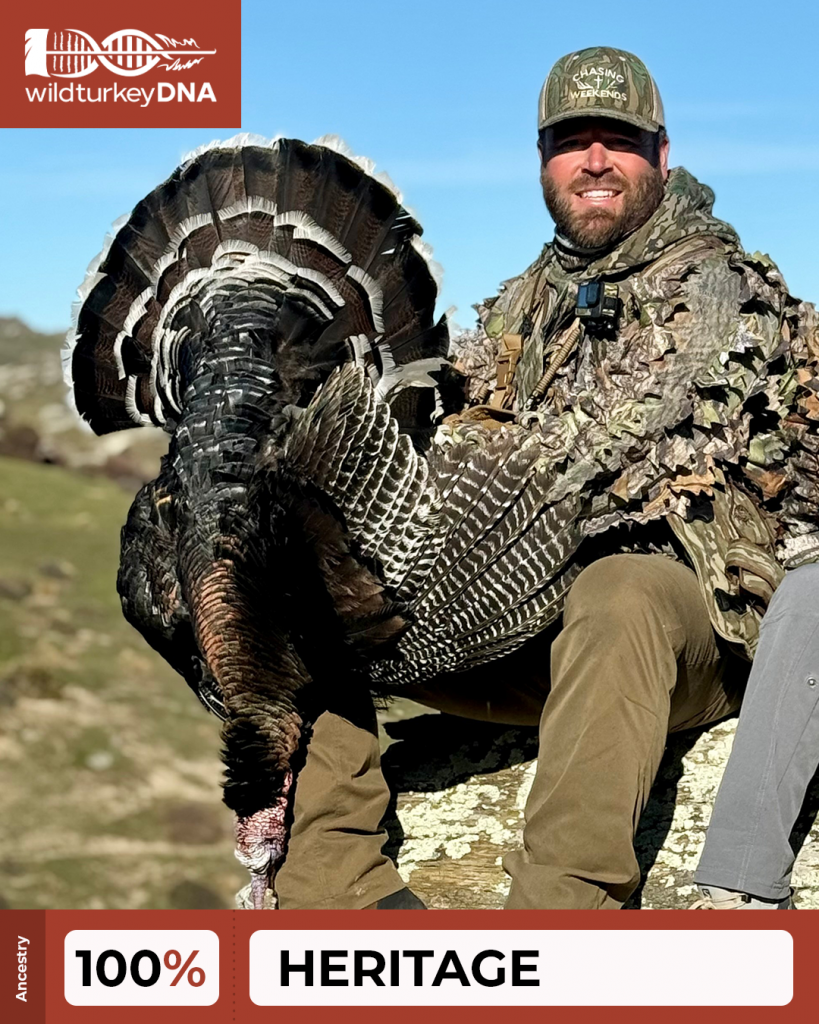
“Many of these solid-white [leucistic] birds are 100 percent wild,” he said. “That’s surprising. We were not anticipating that.
We’re unsure what’s causing it, but we’re going to nail that down.”
WildturkeyDNA is gathering steam going into its third year.
“The plan between now and next spring is to evaluate some of the areas where we’re lacking samples — say within particular states — and determine whether that’s an issue or if we have enough data already,” Chamberlain said. “Also, the plan in 2027 is to do more targeted sampling where our preliminary analysis suggests that it’s worth doing more intensive sampling to make sure what we’re observing in the data is real and not a consequence of sample sizes.”
Most samples have come from the Eastern turkey range. Chamberlain said researchers hope to collect more from the West in the future.
“As you go west, you have parts of the landscape that don’t have turkeys at all, and then you have pockets of turkeys,” he said. “We’ve collected samples from some of those pockets, but some we haven’t. We’re going to do some targeted messaging next spring to fill in some of the gaps.”
As the effort progresses, hunters will want to pay attention — not just out of curiosity but for the betterment of the resource.
“Hunters are the backbone of the study itself, and the project doesn’t happen without their support and willingness to contribute samples,” Chamberlain said. “This project is the largest citizen-science study ever conducted on the wild turkey and has already generated the most spatially comprehensive genetics dataset ever collected on a game bird. Also, there is potential that one outcome of this study will be the recognition that through targeted translocations, state agencies may be able to improve genetic diversity and offset declining reproduction through the introduction of novel genetics into local populations. Therefore, this study has the potential to influence the future of wild turkey hunting and the sustainability of wild turkey populations throughout their range.”
Chamberlain said response and participation from the hunting community has been tremendous, and he expects that to continue.
“One thing that has been awesome is just how much positive attention and how many positive comments we’ve heard from turkey hunters,” he said. “That’s been a pleasant thing to see. It tells us that hunters see value in what we’re doing. And that to me is the coolest part of this project: It’s hunter driven.”