Turkeys on the Move: Arizona Relocation Effort Aims to Strengthen Merriam’s Population
Earlier this month, wild turkey conservation was in action in central Arizona, as the Arizona Game and Fish Department, alongside employees from the Prescott National Forest and staff and volunteers from the National Wild Turkey Federation, came together for a hands-on wild turkey relocation effort.
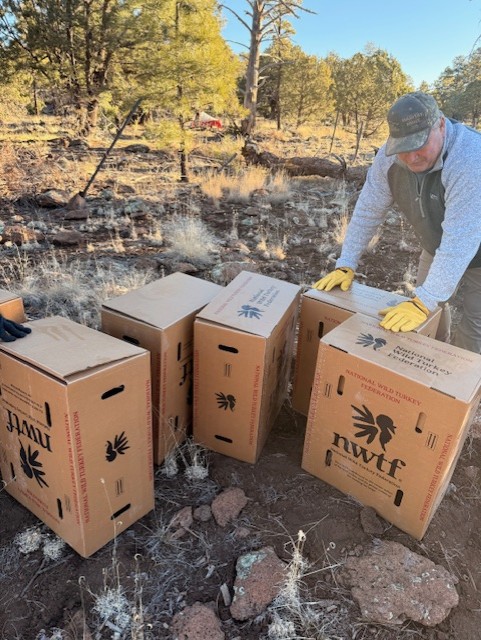
The day before the release, approximately 25 wild Merriam’s turkeys were carefully captured in eastern Arizona and transported across the state. While the physical act of moving birds is demanding in its own right, this relocation represents far more than a single conservation action. It is part of a multi-year research initiative that blends GPS technology, soft-release techniques and long-term monitoring to better understand survival, nesting behavior, habitat use and, ultimately, what it takes to sustain wild turkey populations on the edge of their range.
Arizona’s wild turkey story is one of early success, hard lessons and renewed opportunity. In 1963, turkeys from Units 6A, 6B and 8 were transplanted into the Black Hills, creating a robust population that persisted through the early 1970s. But by the 1980s through the early 2000s, that population declined to near extirpation.
Releases in the late 2000s helped re-establish turkeys in the region, yet today the population remains small and increasingly isolated. Rapid growth in the Prescott Valley and Verde Valley, combined with the area’s position on the western edge of Arizona’s turkey range, has limited natural expansion and genetic exchange between flocks.
At the same time, large-scale habitat work — including prescribed fire, timber thinning and water developments tied to the Black Hills Vegetation Management Project — has dramatically improved habitat conditions ought to be critical limiting points for turkey population stability and growth.”
“This has likely resulted in increased habitat quality and availability,” said Sean Britton, Arizona Game and Fish Department terrestrial wildlife specialist. “As a result, the Department determined that the area would benefit from additional turkey releases to encourage occupancy of all unoccupied habitat and promote genetic diversity. There could also be some spillover effect into the turkey habitat along the Verde River through dispersal.”
What sets this effort apart is how closely it is tied to research. Roughly 30% of the translocated turkeys are fitted with GPS transmitters, allowing biologists to monitor survival, movement, nest initiation timing, nesting habitat use and nest success — data points that are critical for making informed management decisions.
“Monitoring nesting behavior of transmittered turkeys will also help the Department to better time spring hunt seasons, because the assumptions about average nest initiation dates may no longer hold perfectly in modern conditions,” Britton said. “Monitoring nest success could also inform our understanding of nesting habitat needs, given that nest success and brood rearing success are thought to be critical limiting points for turkey population stability and growth.”
This work is supported in part through NWTF’s Request for Proposals program, which invests in innovative science aimed at addressing the most pressing challenges facing wild turkeys nationwide. In Arizona, that science includes testing the effectiveness of soft-release methods, a technique designed to reduce stress and immediate post-release mortality.
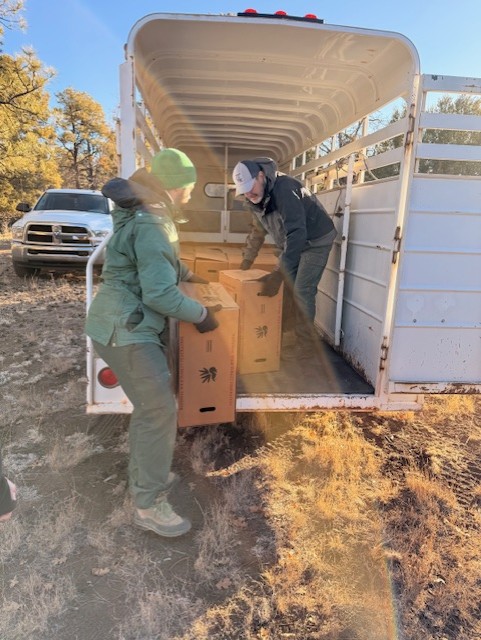
“We're putting GPS transmitters on approximately 30% of translocated turkeys to monitor survival, nest initiation timing, nesting habitat use, and nest success where possible,” Britton said. “Both releases in Unit 19A the past two years have used the soft release method for all or most of the turkeys. Although more replication and analysis is needed, these two releases appear to have had fewer immediate post-release mortality issues than earlier efforts in the region that did not use the soft release method.”
Kirsty Paulsen, NWTF hunting and R3 coordinator in Arizona, was on hand to help with the release and see the process up close.
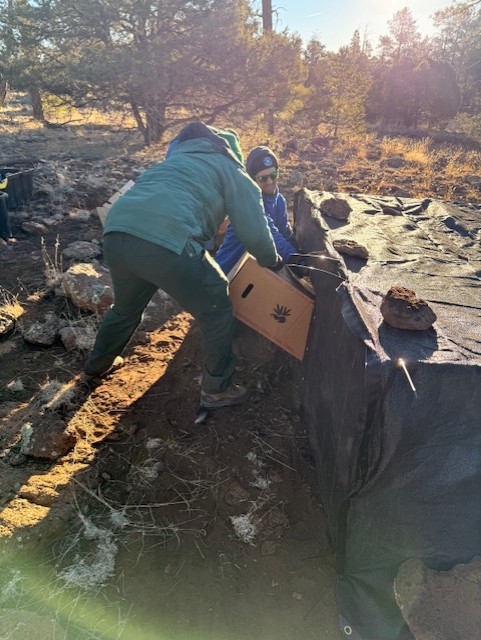
“We first constructed an enclosed pen and covered it with dark mesh netting to prevent the turkeys from seeing outside,” Paulsen said. “Turkeys from the transport boxes were placed inside, allowing the birds 30 to 45 minutes to adjust to their new surroundings. After that acclimation period, all of the turkeys were released at once.”
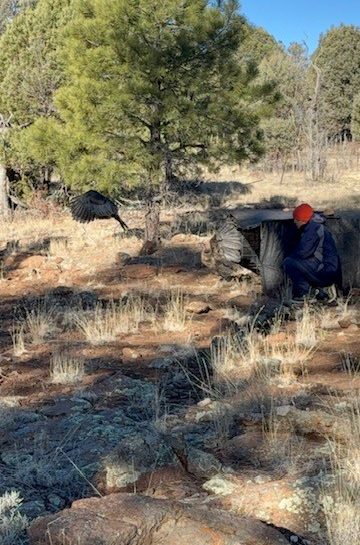
Following the release, the Arizona Game and Fish Department continues to closely monitor transmitter data to detect potential mortalities.
“Although this typically happens when the turkey has died, these signals often come in misleadingly on winter mornings as the birds tend to roost later when it's cold,” Britton said. “In cases where mortality signals are transmitted from a location without roost trees or late in the day, game and fish personnel will go out to try to determine the cause of death if the bird is in fact deceased. Most mortalities are likely the result of bobcat or coyote predation, although it is often difficult to determine.”
As the seasons progress, the research will also shift its focus to nesting activity, which is critical for understanding population stability and growth.