Rain Day Revelation
After decades of experience chasing gobbles in rainy weather, the author has compiled his revelations and has made the case for rainy-day turkey hunting.
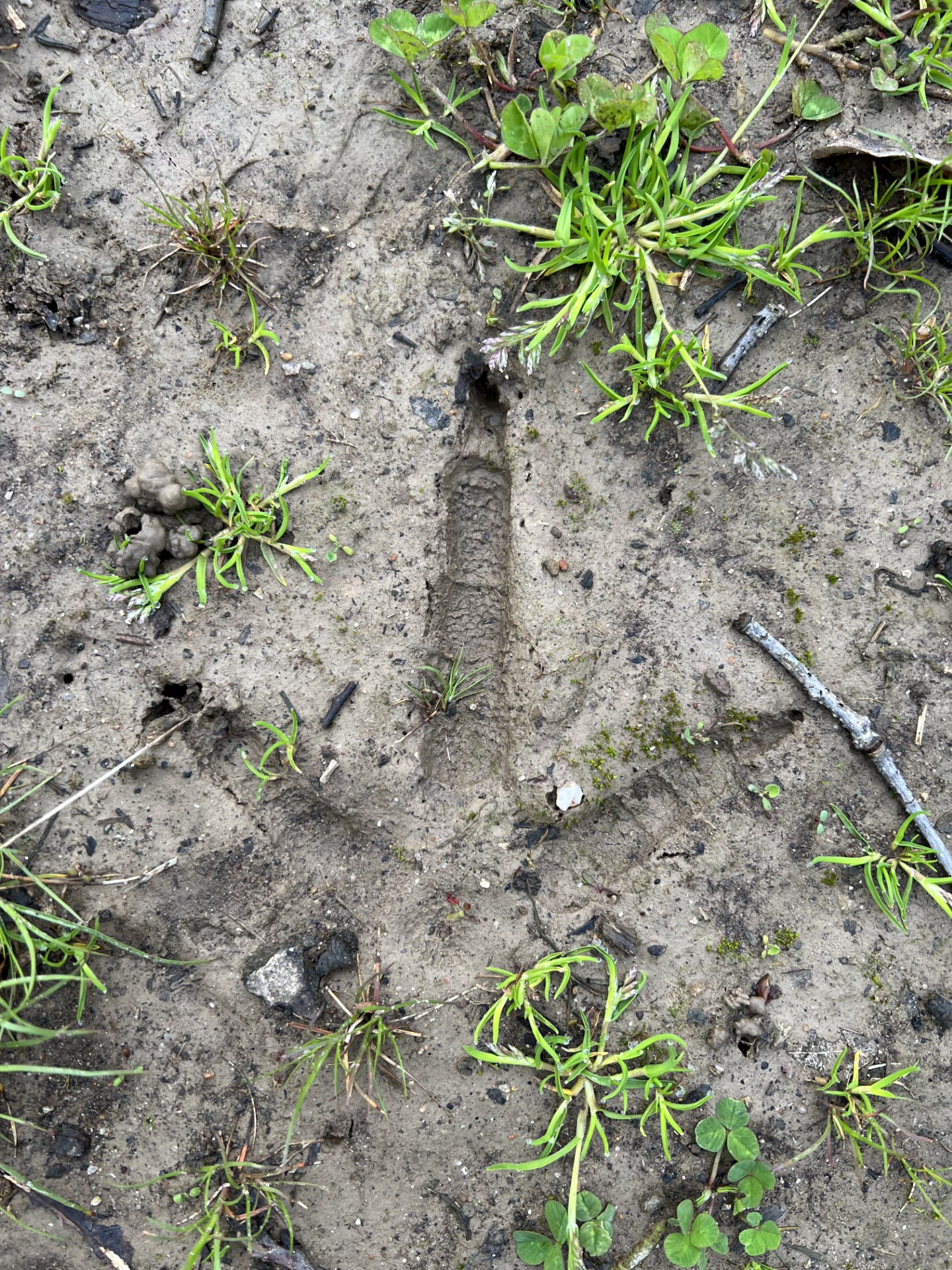
Rain can be a welcome ally to the serious turkey hunter. The “dogs that hunt” intimately understand the difference between hunting “in” rain and hunting “with” rain.
Rain teaches illuminating lessons to those who attend the class. A gentle, invigorating rain relaxes all the living beings outside, savoring the soothing tranquility. For example, witnessing the symbiotic association of wild turkeys and deer when they forage together on a rainy day is an amazing lesson to enjoy. Turkeys welcome the help provided in wind and rain by the keener senses of smell and hearing of the deer. And deer will eagerly share mast raked up by an industrious drove of turkeys. For the willing turkey hunter, a slow steady rain can set the stage for a relaxing day afield and often a rewarding day as well.
Issues presented by heavy rain are not to be denied, certainly, but they needn’t impose the concerns and limitations some hunters would assess. A hunt can take an interesting turn when rain redirects a game plan, at least for stalwarts who elect to stay the course. Weather changes and low-pressure systems, however, call for a modest change of tactics.
Of Foremost Concern
If you think you want to get serious about inclement weather hunting, there is one initial consideration first above all else. Appropriate clothing, from head to toe, is the order of the day.
Today’s high-tech raingear is innovatively designed and offers the opportunity to hunt in almost total comfort. Research, locate, try on and invest in the most dependable wet weather clothing your budget allows. Good, quiet rain gear and appropriate boots are investments that earn their price tag.
Also don’t forget that rolling thunder can rev up a hunt by inducing intense shock gobbles from nearby turkeys that would otherwise be tight-beaked. Excitement may peak, but don’t fail to remember there is no clothing that repels lightning (avoid hunting in dangerous conditions).
Above all else be smart and be safe!
Gear vs. Gadgetry
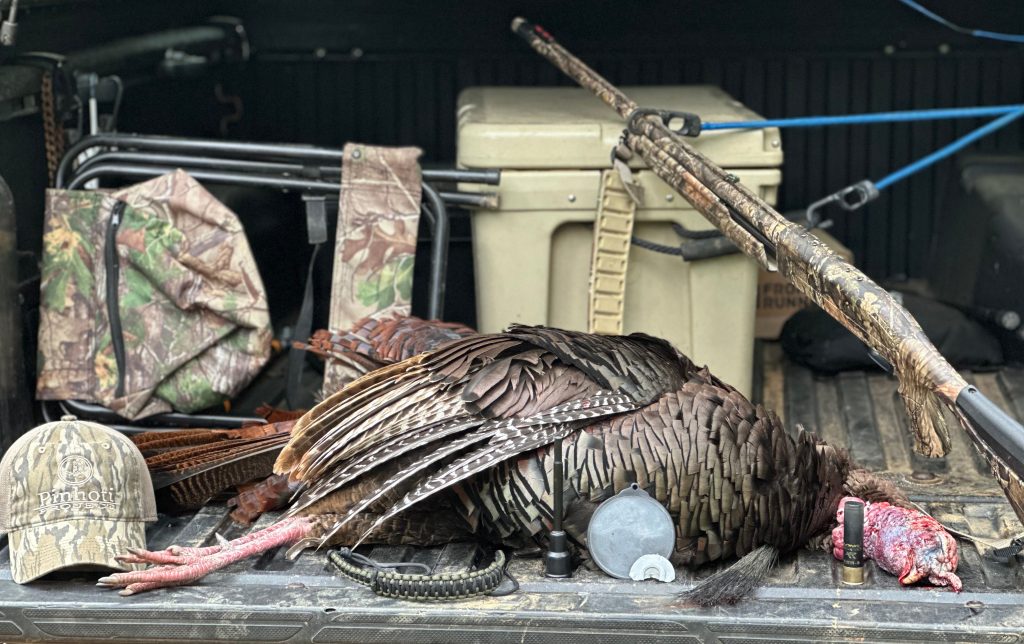
If the plan is to venture afield, minimizing gear for rainy days is key.
It isn’t necessary to pack a full arsenal. Essentials need not include more than a lightweight binocular, selected mouth calls, a trusted waterproof friction call, a gun and shells.
Notably, on weather days very high frequency waterproof friction calls can ellicit distant gobbles; their piercing screeches can cut through weather challenges when other call choices can’t do the job.
Trust binocular optics to provide visual assurance of a distant field bird’s behavior and response to attempted calling efforts. It is not uncommon to observe the vigorous gobbling of far-off birds and not be able to hear them through heavy wind and rain.
One other important gear consideration that bears repeating is footwear choice. Wet woodlands, often offering invitingly quiet walking, are at the same time treacherously slimy and slippery. Choose a boot with a sole suited to the terrain.
Field Attractions
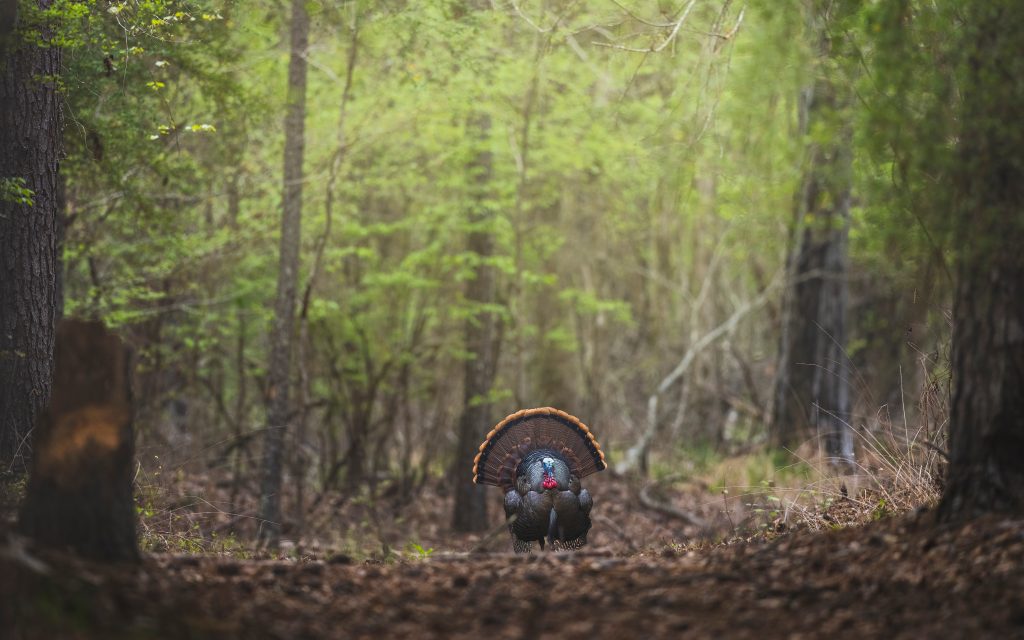
One of the most valuable lessons gleaned from my years attempting to rationalize wild turkey behavior patterns is their preference for seeking out the comfort zone of an open field when steady rain is the weather pattern of the day.
Their choice is made with good reason, as (I am learning) is usually the case with all their behavioral traits.
In fact, three paramount priorities drive turkey behavior in regard to choosing open fields to endure persistent rain. With no attempt to assign rank, the priorities involve concern for: seeking protection from predation, procuring provisions for the day’s menu, and propositioning cooperative hens (even in the rain). Which priority takes precedence depends on the bird and the day.
The safety of an open field for turkeys on a rainy day is easily explained. For the turkey, normal sight and hearing ability is often compromised in steady rain and even more often decimated in a hard-driven torrential thrashing. The middle of an open field provides a safe harbor where birds have a chance to deal with predation pressure. As added incentive, spring fields are most often close-cropped with short vegetation and provide comfortable respite from movement through thick cover that is dripping wet.
Worth noting too, if wind is present and birds choose to be moving, they prefer travel into the wind given the choice. Moving into the wind is their natural path of least resistance. With oily feathers tightly tucked, the birds become anatomically aerodynamic and water resistant (another of the Master Designer’s wonders).
As for procuring provisions, food offerings may abound and open fields can predictably provide a full course menu for the fortunate opportunistic omnivores.
Freshly plowed fields when rain soaked become a mucky nightmare for a hunter to navigate but never seem to discourage or deter traveling turkeys on a mission to raid Mother Nature’s larder. High-protein offerings seem especially abundant and most favored. Worms, grubs, snails, salamanders, skinks, snakes, wayfaring crayfish and frogs all hold revered positions on the menu.
Other attractions are the spring seeps that provide the first succulent green vegetation of the season. The allure of nature’s salad bar is magnetic. And not just to turkeys.
The prioritized rituals of spring pursuant to procreation of the wild turkey are well documented and reasonably familiar to the turkey hunter. Suffice it to say an open field is a likely place for courting capers to play out. Seldom is the game called on account of rain.
Field Maneuvers
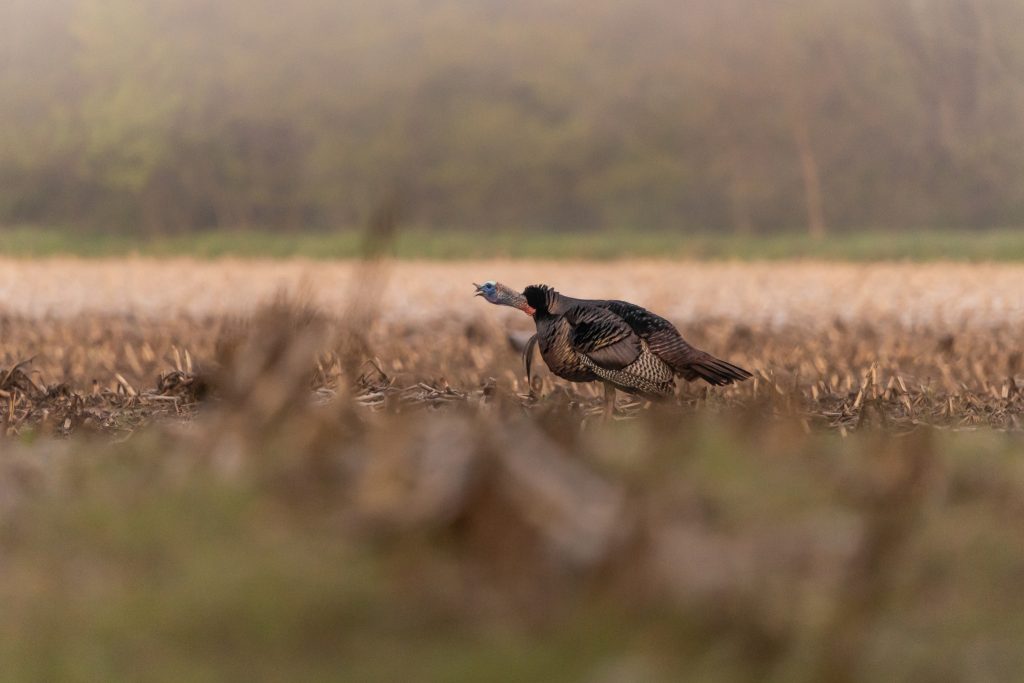
Learning which fields may offer quality rainy day hunting opportunities results from dedicated, disciplined, preseason and in-season scouting. Why, when and where questions necessarily need to be addressed and hopefully answered. Having already addressed some of the important prompts that send turkeys to fields during rain, consider now some when and where concerns.
What time turkeys show up in fields may be a behavior pattern worth logging and tracking. This intel, too, is attained through diligent preseason and in-season scouting.
Important “where” considerations include making note of routine or preferred entrance and exit portals used by birds frequenting a given field. Points of entrance and exit are usually chosen as a result of existing terrain features, safety considerations or other topographical influences. Interestingly, scouting log entries may reveal an expected arrival time for turkeys to enter a preferred field. Of equal interest is any regularity in the time they choose to leave.
All logged information is key to revealing routine travel routes used that will assist immensely in considering worthy choices for set up locations. A hunter positioned where birds already intend to travel is also in a position to make an inquiring cluck to help steer their course, maybe even encourage an early departure from the sanctuary field.
Needless to say, however, there are no givens, gimmes or guarantees in fair chase turkey hunting. But intel gleaned from repeated recon missions will shore up the confidence required to patiently stay the course.
The challenge of maintaining adequate patience may seem unfathomable. Just remember, patience is power. It is not an absence of action; rather, it is an intricately defined form of action. It is “timing.” It waits on the right time to act, for the right reasons and in the right way.
Field hunting success is powered by knowing how long it takes to succeed. It is about using time spent to be present in the moment, experiencing awe and building self-confidence. And it is confidence, after all, that fires the burning wick in the candle of patience.
Fog Features
Lest we forget, with rain comes the omnipresent possibility of fog, and pea soup fog presents its own impossible-to-ignore set of challenges to the turkey hunter.
Vision is obviously impaired. Hearing is often distorted and misdirected. Both the hunter and the hunted birds face perplexing issues.
The thicker the blanket of fog, the deeper the concern for exercising strict safety precautions.
Choreographing an eventual safe-and-sound arrival to a preferred set up spot in fog requires some forethought. With fog in the forecast, it makes sense to choose familiar territory.
Additionally important, the time allotted to get in to a predetermined set up location must not be underestimated. Allow even more time than would be expected to follow a familiar fence line or field edge. The goal is to get into place early and safely; that being accomplished, staying put until the fog lifts is a good plan.
In any fog situation, the need for somehow accurately determining possible shot distances is imperative. In a familiar set up position pre-determined distances become invaluable intel. Guessing distances in fog is foolhardy at best. Apparent shot opportunities may actually be closer than those naturally taken under clear conditions. And knowing where your gun patterns within as few as ten yards is key. Specifically, knowing how tight a pattern, high or low within an inch, you can expect your gun and chosen load to perform is important.
If on a fogged-in morning you happen to find yourself lured to a set up where you had roosted birds the night before and if you arrive in time to be comfortably awaiting the first gobble, be prepared for roosted birds to stubbornly remain in the roost for a spell rather than lift off into the fog of unknown territory. Also, don’t be dismayed to be met with nerve wracking silence; however, the exact opposite scenario is entirely possible as well. Birds unable to see each other may sound off taking role call for whatever time may be needed for accountability.
If and when birds finally decide to fly down while fog persists, they will often drop straight down making ground fall in eerie silence. Once on the ground, they are understandably even more wary and uncertain.
Dealing with a bird on the ground that actually does respond to judicious calling can result in quite the exasperating engagement. Often a vocal bird will circle (and circle) even more than usually anticipated. No matter how “hot” that bird may be, his instincts seem to keep him “in the fog.”
But remember! If the fog lifts, low and behold, you are already in place and comfortably situated in “the catbird seat.” Your effort and preparation time expended has been rewarded.
For What It’s Worth
As with any hunt, a rainy-day hunt has no failsafe path to success. And there are those who would forego the hunt because of post-hunt time that must necessarily be allotted to properly attend to gear. Stuff must be cleaned and dried out, with first priority being a shotgun. (Note: Take care of your equipment and it will take care of you.)
Also, steps taken to blow dry or otherwise prepare a tagged turkey for a responsible picture, composed to show respect for the bird and to honor a special hunt, take time.
Nevertheless, the next time the sky is darkened ominously with the threat of rain on the horizon, remember this: bad weather is not necessarily a bad omen.
As a final thought, I never learned the original source of one of my mother’s favorite sayings, but she got a lot of mileage out of the words: “Life isn’t about waiting for the storm to pass, it’s about learning to dance in the rain.” Amen.