
How Many Turkeys Are There?
One of the most basic questions in wild turkey science and management is also one of the hardest to answer. How many turkeys are on the landscape?
That may sound simple, but anyone who has spent time around wild turkeys knows they are difficult to count. In many parts of the country, turkeys spend much of their time in forested, closed-canopy landscapes where visibility is limited. They move across property lines, flock together during some seasons and spread out during others. Unlike white-tailed deer, where unique antler characteristics can help identify individuals, most wild turkeys look similar.
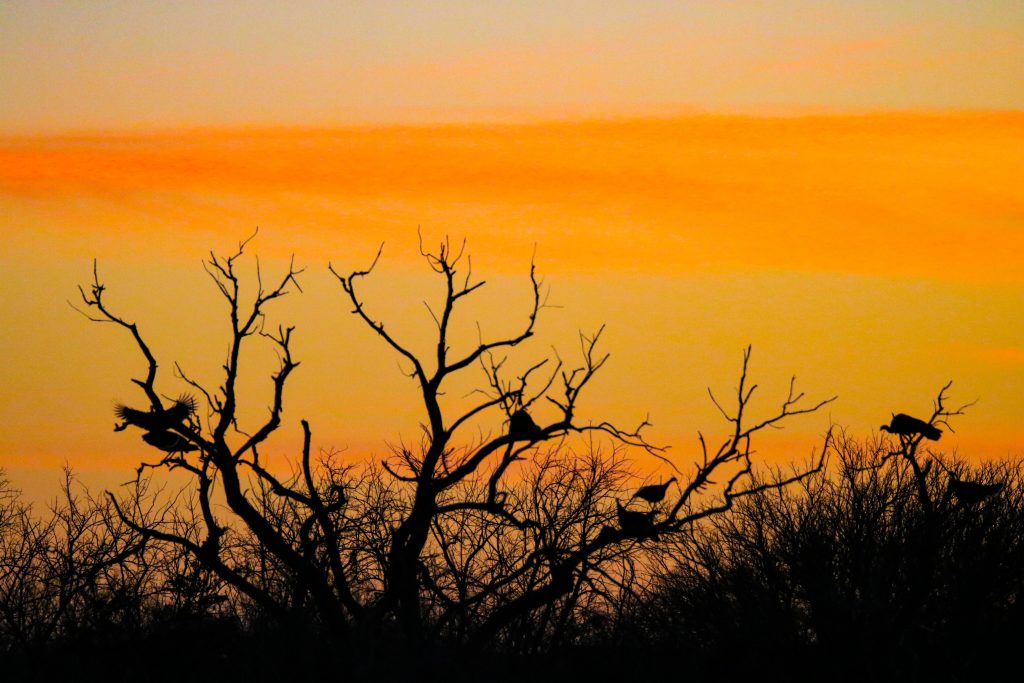
Because of that, managers often rely on harvest numbers, hunter observations, brood surveys or gobbling activity to understand whether populations are increasing, decreasing or stable. Those tools are valuable, but they have limitations. Harvest numbers can change when turkey populations shift, but they can also change due to variations in hunter effort or behavior, weather, hunting access or regulatory changes. Brood surveys track reproduction, but they do not always tell us how those observations translate into population size.
This is why abundance estimation is a research priority for the NWTF Research Grants Program. Over the last five years, NWTF has invested in more than half a dozen projects designed to develop better ways to estimate turkey abundance or population trends at local, state and regional scales. If managers want sustainable wild turkey populations, they need to know how many birds are on the landscape and whether that number has changed over time. They also need ways to evaluate whether habitat management, predator management, harvest regulations or other factors influence population size.
Researchers are approaching the question from several directions. Some are using genetic analyses from feathers and fecal material. Others, like Dr. Mike Chamberlain, are looking at wild turkey DNA, using blood and tissue samples from captured birds and hunter harvests.
Cameras are common tools for hunters and managers, but identifying individual turkeys from photos remains difficult. Researchers are exploring whether colored leg bands, paired with GPS data on movement and home-range size, can make marked birds easier to identify and help estimate abundance at finer property or management-area scales.
At broader scales, published work supported by NWTF from the University of Florida and Dr. Corey Callaghan demonstrated how citizen science, agency observations and camera-trap data can be integrated to better understand where turkeys are more or less abundant. Much of that work estimates relative abundance, which is useful in certain instances, like showing the value of the Florida Wildlife Corridor, but is not the same as an estimated count in an area.
New technology such as drones equipped with thermal cameras, paired with deep-learning tools, could count roosting wild turkeys. Published research on this topic from Dr. Michael Byrne’s lab at the University of Missouri demonstrates the potential but acknowledges challenges remain, including weather, forest canopy and distinguishing turkeys from vultures.
Population models are also valuable tools. A 2026 Journal of Applied Ecology paper by Veronica Winter et al. used detailed local information, including marked birds and telemetry and harvest data from specific wildlife management units, to inform another model using data already collected at larger scales. In other words, they showed how intensive research from a few areas can improve population estimates across larger management regions.
A new NWTF-supported project in Michigan is asking a related question. Michigan currently uses hunter effort and harvest data to estimate an annual index of spring male abundance, but researchers want to know whether those trends truly reflect what is happening in the population. By adding banding, marked-bird data, survival, nest success, brood survival and harvest probability, the Michigan project hopes to evaluate whether harvest-based indices are accurately tracking abundance. If they are, those tools could provide a cost-effective monitoring approach. If not, the work can help identify where the model needs improvement.
In Georgia and South Carolina, work from the Wild Turkey Lab, run by Chamberlain and supported by the NWTF, is evaluating whether autonomous recording units and individual gobbling behavior can help estimate male abundance. If researchers can better understand when and how often individual birds gobble and whether individual males can be identified from recordings, gobbling surveys could become more useful for tracking local male abundance.
The takeaway is that there is no single perfect way to count wild turkeys – at least right now. Each method has strengths, limitations and a different scale where it may be most useful. Progress is coming from testing tools, combining approaches and asking which methods best answer specific management questions. Better abundance estimates will not solve every challenge facing wild turkeys, but they will give managers a stronger foundation for making decisions. If we want to know whether populations are changing and whether management actions are helping, we first need better ways to count wild turkeys.