Ask Dr. Tom: Beard Abnormalities
Dr. Tom trims up oddities in wild turkey beard growth.
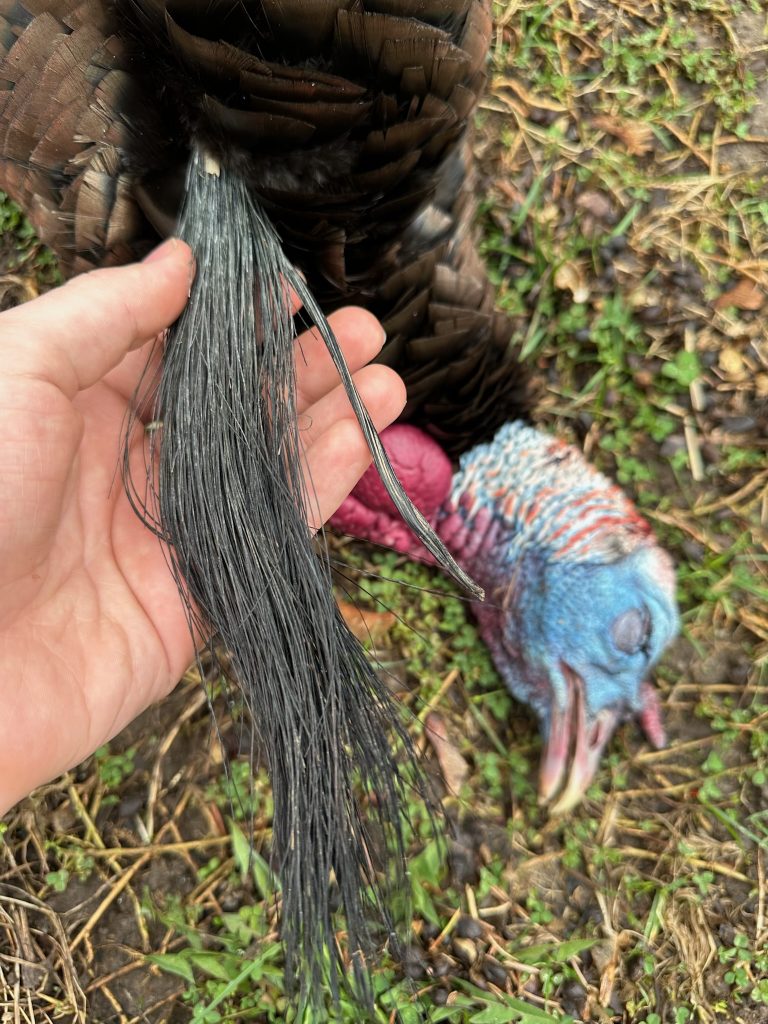
Thank you for sharing your photo of the odd beard. That bird was a good adult tom. This gobbler exhibited what might be called a “split beard.” It is not a double beard, but one in which a portion of the beard separates from the rest of the structure. I have similar beards in my collection and have seen a few taken by other hunters.
Wild turkey beards have often been referred to as modified feathers. The bristles or filaments that comprise the beard show some characteristics of feathers in that they are keratinous. Keratin is a protein found in feathers; however, unlike feathers that are molted and replaced annually, the beard is not shed. Some researchers believe that rather than being modified feathers, beards are simply a specialized structure of the skin. Either way, beards sure generate interest among hunters.
Beards are a secondary sexual characteristic turkeys use along with other attributes to evaluate physical condition and suitability for mating. They emerge from a raised oval of skin called a papilla, follicle or sheath. Most gobblers have a single papilla, but some specimens have multiple papillae and can develop multiple beards.
When beard filaments emerge from the papilla, they are coated with a whitish oily, waxy or cementlike substance, which is probably part of the development process. The coating dries and usually breaks down and flakes away as the beard grows. The cement-like coating gives the part of the beard closest to the papilla a grayish color rather than appearing black like the rest of the beard.
In the case of your friend’s gobbler, it appears that a portion of the beard was isolated from the rest of the bristles as it developed, resulting in the split. The waxy coating failed to break down on the narrow, split portion and remained intact, encasing the bristles. Whatever the reason, the split beard is an unusual trophy and a reminder that gobblers are unique individuals.
Through my years of wild turkey research and spring gobbler hunting, I’ve seen a variety of beard anomalies. Lifelong researchers like A.W. Schorger, Lovett Williams, Jim Dickson and James Earl Kennamer described odd beards they encountered in their written research. Some authors reported amber (reddish orange) filaments in short beards developing on jakes. I also noted that oddity in a few specimens. As the beard grows longer, the bristles are black and the amber end wears off. The amber color is likely due to a lack of melanin, the pigment that causes turkey beards to be black in their early development.
A temporary lack of melanin at some point in the beard’s development can result in a band of amber in an otherwise normal black beard. Such an oddity might be seasonal and caused by a nutritional deficiency or a short period of poor health in the bird’s life. Other specimens exhibit “tiger-striped” beards with two or three sections of a normal black beard interrupted by ¼- to ½-inch amber bands. Those oddities likely result from a seasonal lack of melanin and may be nutritional in origin.
Some gobblers may be unable to produce sufficient melanin to develop black beards. Several authors reported amber beards and, less commonly, blond beards. Though I have not handled such specimens, I have seen photos of orange and blond beards from at least three wild turkey subspecies. These rare oddities generate lots of interest. Entire beards that are oddly colored are likely due to a highly unusual genetic factor.
The more time you spend watching wild turkeys, hunting or researching these fine birds, the more fascinating you find them. Thank you again for sharing your photo and for contacting NWTF with your questions. Interacting with folks who value our wild turkey resource and our hunting tradition is a pleasure.
Send your wild turkey questions, photos and videos to turkeycall@nwtf.net for Dr. Tom to answer.